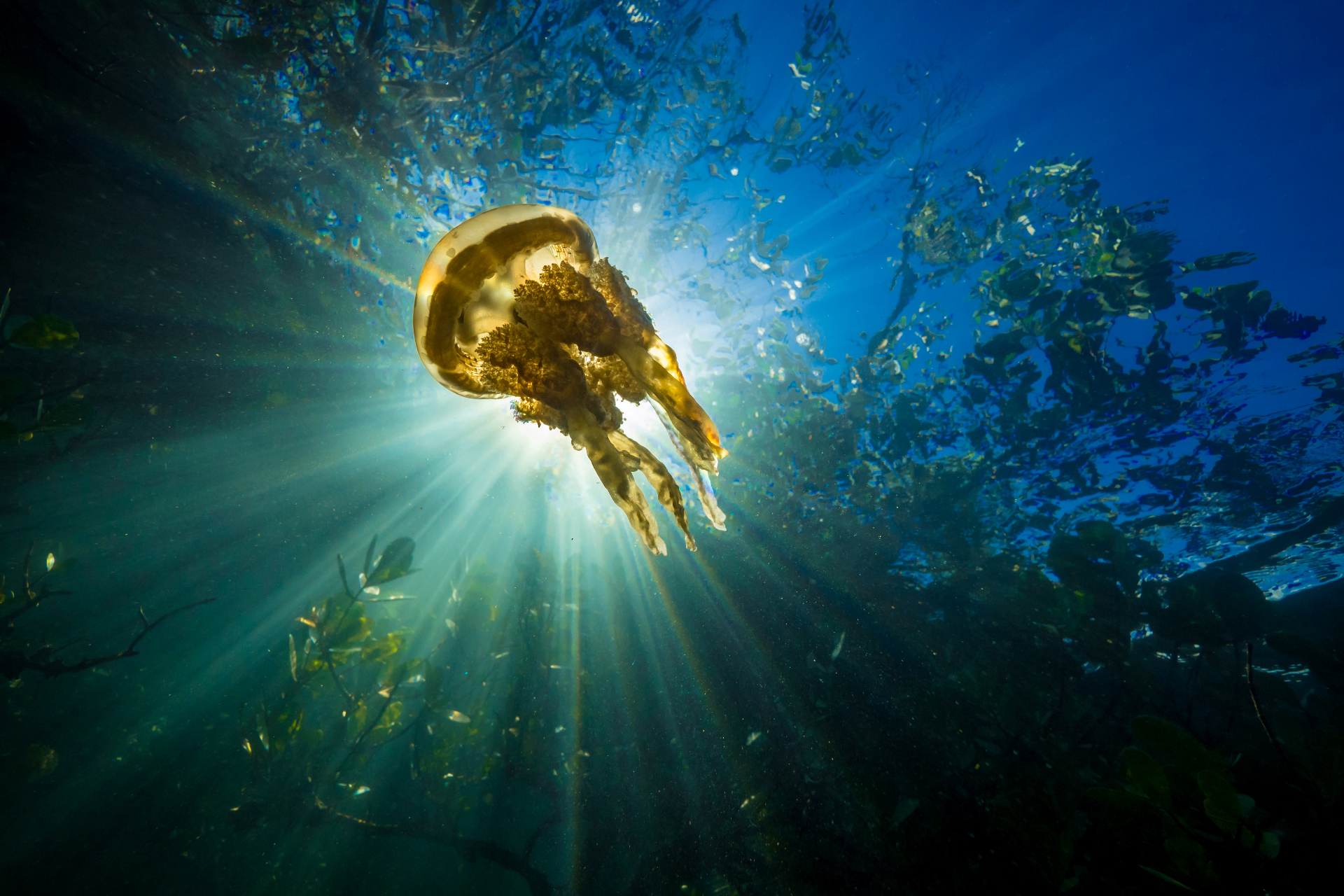
The iconic film director Alfred Hitchcock once said his idea of perfection was a “clear horizon.” He meant it metaphorically, but I always remembered the quote, sitting oceanside with a cloudless sky and calm sea. For me that perfection was the horizon where the ocean meets the sky, though even as one says it, the phrase feels imprecise. There is no true meeting there, no seam where water ends and air begins. There is only a soft convergence, a shifting band of light where blue dissolves into blue. From this place, the land at my back, the sea before me, and the sky above seem less like separate realms than parts of a single, continuous world.
Astronaut, aquanaut, and artist Nicole Stott reflected on it in her book, Back to Earth: “From space, you see this incredibly thin line of blue that wraps around our planet. It’s so thin that it’s almost unbelievable that everything we need to live is contained within it. That line is our atmosphere, but it also represents so much more. It holds the air we breathe, the water that cycles through our oceans and clouds, and the delicate balance that makes life possible. Looking at it, you realize how interconnected everything is. The oceans, the land, the air, they’re not separate systems. They’re all part of this one, fragile layer that sustains us.”
It is from such a perspective that one begins to understand the Earth not as a map, or a system of coordinates, but as a continuity.
We have been taught to divide the world. The ocean is something we cross, the sky something we look through, space something we reach toward. Yet these divisions are conveniences of language, not of nature. The ocean does not end at the shore; it becomes vapor, rises, drifts, condenses, and returns. The sky does not end at the cloud tops; it thins gradually, molecule by molecule, into the darkness we call space. There is no sharp boundary anywhere in this ascent, only a gradient, a thinning, a fading, a continuous transformation.
This is what we call the Blue Continuum: the thin, living membrane of ocean and atmosphere that wraps our planet and makes it alive.
The planet's skin
Seen from a distance, as Carl Sagan reminded us, the Earth is a pale blue dot suspended in a sunbeam. But the phrase, so often repeated, risks becoming decorative unless we understand what gives the dot its color. The blue is not merely the reflection of sunlight off water and air. It is the visible sign of a deeper fact: that the Earth possesses a coupled system of ocean and atmosphere, circulating energy and matter in a ceaseless exchange, sustaining life across scales both vast and minute.
Remove that system, and the planet would still be here. The mountains would stand, the continents would drift, the iron core would turn. But it would be a silent geology, like Mars or the Moon, a world of rock without respiration. What distinguishes Earth is not its solidity, but its skin.
“What distinguishes Earth is not its solidity, but its skin.”
And that skin is astonishingly thin. The deepest parts of the ocean descend some eleven kilometers. The atmosphere, though it feels boundless to us, contains most of its mass within the first ten or fifteen kilometers above the surface. Against the Earth’s radius of more than six thousand kilometers, this is scarcely a film, a varnish, a breath. If the planet were reduced to the size of an apple, the entire domain of life would occupy less thickness than its peel.
Yet within that peel, everything happens. The ocean absorbs the heat of the sun and redistributes it across the globe, carrying warmth toward the poles and cold toward the equator in slow, immense currents. The atmosphere responds in kind, setting the air in motion, winds, storms, jet streams, shaping weather and climate. Water evaporates from the sea, rises invisibly, and returns as rain or snow, carving rivers, nourishing forests, filling aquifers. Carbon moves between ocean and sky, dissolving, precipitating, feeding the long cycles of life and decay.
An exuberance that borders on the miraculous
And in the midst of these exchanges, life arises, not as an addition to the system, but as an expression of it. Here, in this narrow band, is an exuberance that borders on the miraculous. Coral reefs, built slowly by tiny organisms, rival rainforests in their biodiversity. The open ocean, once thought empty, teems with invisible life, phytoplankton, zooplankton, whose numbers are beyond counting and whose activity sustains the chemistry of the planet. In forests and grasslands, in soils and rivers, in the thin films of microbial life that coat rocks and roots, the same pattern repeats: diversity emerging from continuity.
It is easy to overlook this abundance because it is so finely distributed. A liter of seawater may contain millions of living organisms. A handful of soil may hold more species than a city. Even in the upper atmosphere, microbes have been found drifting on currents, carried across continents and oceans. Life fills the continuum not in isolated pockets, but as a pervasive presence, woven into every layer.
And this diversity is not ornamental. It is functional. Each organism participates in cycles larger than itself, transforming energy, exchanging gases, building and breaking down the molecules on which others depend. The resilience of the system lies in this multiplicity. We speak often of preserving species, and rightly so. But what we are preserving, more fundamentally, is the integrity of this living continuum, the intricate web of interactions that allows life to persist at all.
Deep sea, deep space
And yet, we persist in imagining boundaries. We speak of the “deep sea” as though it were a remote world, alien and inaccessible. We speak of “outer space” as though it began at a fixed line, a threshold to be crossed. But the truth is more subtle. The deep sea is not separate from us; it is connected through currents, through chemistry, through the oxygen in our blood. Space does not begin abruptly; it is the continuation of the same atmosphere that surrounds us, thinning gradually into vacuum. What we call “deep” and “outer” are points along a single continuum.
To unite the deep sea and deep space under the idea of the Blue Continuum is not a poetic gesture alone; it is an attempt to correct our perception. For we are a species that has learned to explore both extremes. We have sent submersibles into the abyss, where sunlight never reaches and pressure would crush an unprotected body in an instant. We have sent spacecraft beyond the atmosphere, into the silence where there is no air at all.
There is a symmetry in this. The remotely operated vehicle descending into the ocean’s depths and the telescope peering into distant galaxies are both prosthetics of human curiosity. They allow us to inhabit regions of the continuum that would otherwise be closed to us. They convert darkness into image, pressure into data, distance into meaning. But they also reveal something more profound: that our reach, whether downward or outward, is anchored in the same thin layer of life.
Every mission to the deep sea begins at the surface. Every journey into space must pass through the atmosphere. We do not escape the Blue Continuum; we depart from it, and in doing so, we carry its conditions with us, air, water, temperature, pressure, carefully recreated within the vessels that sustain us. The astronaut and the aquanaut share the same fundamental challenge: to preserve a fragment of Earth’s environment in places where it does not naturally exist.
A system in motion
This recognition alters the way we think about exploration. It is no longer a matter of leaving the Earth behind, but of understanding the extent to which we are bound to it. At the same time, the Blue Continuum is not static. It is a system in motion, responsive to change. Over geological time, it has shifted and adapted, absorbing perturbations, maintaining a dynamic equilibrium. But the scale and speed of human influence now test that resilience.
We alter the composition of the atmosphere through the release of greenhouse gases. We change the chemistry of the ocean through the absorption of carbon dioxide. We warm the surface waters, melt the ice, shift the patterns of circulation that have persisted for millennia. These changes are not confined to one domain. They propagate through the continuum, linking sea to sky in ways that are sometimes subtle, sometimes abrupt. A warming ocean alters the behavior of storms. A changing atmosphere affects the distribution of rainfall. The boundaries we imagine dissolve under the pressure of these connections.
To see the Blue Continuum clearly is to understand that there is no “away” into which we can cast our consequences. There is only the system itself, and our place within it. We must learn to see the Earth not as a collection of resources, nor as a backdrop to human activity, but as a continuous, living system in which we participate. We must recognize that the air we breathe has passed through oceans and forests, that the water we drink has cycled through clouds and rivers and ice, and that the very atoms composing that air and water, and our own bodies, were forged in ancient stellar explosions long before the Earth itself existed.
A single continuous story
And yet, there is also possibility. For the same continuity that binds the system together allows us to perceive it as a whole. We can measure the temperature of the oceans, the composition of the atmosphere, the movement of currents and winds. We can model their interactions, anticipate their changes, and, perhaps, learn to act with a greater degree of foresight.
This is where the idea of the Blue Continuum finds its deepest meaning. It invites us to hold in a single thought the depths of the ocean and the reaches of space, to see them not as opposites but as extensions of the same planetary condition. It asks us to consider humanity’s evolving relationship with Earth’s largest living system while also examining our expanding technological and philosophical presence beyond it.
For as we send instruments, and, increasingly, ourselves, into space, we carry with us the question of what it means to be a living species on a living planet. We look outward not only to discover what is there, but to understand more fully what is here. In that sense, the exploration of space is not a departure from Earthly concerns, but a continuation of them. It sharpens our awareness of the rarity and fragility of the conditions that support life. It frames the Blue Continuum not as an inevitable feature of planets, but as a remarkable and perhaps uncommon circumstance.
And the exploration of the deep sea, no less, reminds us that much of our own world remains unknown. It reveals ecosystems that thrive without sunlight, communities of organisms that challenge our assumptions about the limits of life. It expands our sense of what is possible within the continuum, even as it underscores how much we have yet to learn. Together, these explorations, downward and outward, form a coherent view of life from the depths of the planet to the edges of the universe.
They bring into focus a single, continuous story: that of a thin layer of water and air, held against the vastness of space, within which life has arisen, evolved, and become conscious of itself.
And in the end, the Blue Continuum returns us to a simple, disquieting recognition: that the boundaries we draw, between ocean and sky, Earth and space, self and world, are not fixed lines, but conveniences of thought. As Einstein once observed, a human being is “part of the whole called by us ‘Universe’… a kind of optical delusion of consciousness,” and it is this illusion of separateness that the view of our planet begins to dissolve.
For when we look closely, we find that we are not observers of this thin blue layer, but expressions of it, composed of the same atoms forged in ancient stars, sustained by the same cycles of air and water that bind ocean to atmosphere. As Hubert Reeves so beautifully put it, we are “stardust brought to life, then empowered by the universe to figure itself out.”
The Blue Continuum is the stage on which that awareness has arisen, a narrow, improbable span where matter has learned to feel, to think, and to wonder at its own existence. And as we extend our reach into the depths of the sea and outward into the cosmos, we carry with us not an escape from this continuum, but its living imprint. The thin blue line we see from space is not merely the boundary of a planet. It is the condition of consciousness itself, a fragile, radiant film in which the universe, for a moment, has become aware of its own unfolding.
John Steele is the founding editor of Blue Continuum. His writing explores the connections between oceans, Earth, life, and the cosmos, translating scientific discovery into stories that illuminate humanity's place in the unfolding story of our planet and universe.
Connect on LinkedIn →